

PayPal and Venmo Introduce AI-Powered Tools to Detect Scams Before Payments Are Sent
PayPal and Venmo are using artificial intelligence to help users identify potential payment scams before sending money. The new security tools analyze transactions in real time and display warnings when a payment appears suspicious, giving customers an opportunity to stop before losing their money.
As online payment scams become increasingly sophisticated, digital payment platforms are turning to AI to strengthen fraud detection. PayPal's latest approach focuses on identifying suspicious payment patterns and warning customers at the moment they are about to transfer money.
The technology is particularly important for Friends and Family payments, which are commonly used to send money to people users know. These transactions may not qualify for the same purchase protection available for eligible commercial payments, making scam prevention especially important.
PayPal introduced its AI-powered scam alerts for PayPal and Venmo Friends and Family payments in July 2025. The system is designed to identify potentially fraudulent transactions before funds leave a customer's account.
How PayPal and Venmo's AI Scam Detection Works
PayPal's scam detection technology uses continuously learning artificial intelligence models to analyze billions of data points and identify patterns associated with fraudulent payments.
Instead of relying on fixed warning messages, the system evaluates individual transactions and adjusts its alerts according to the level of risk detected.
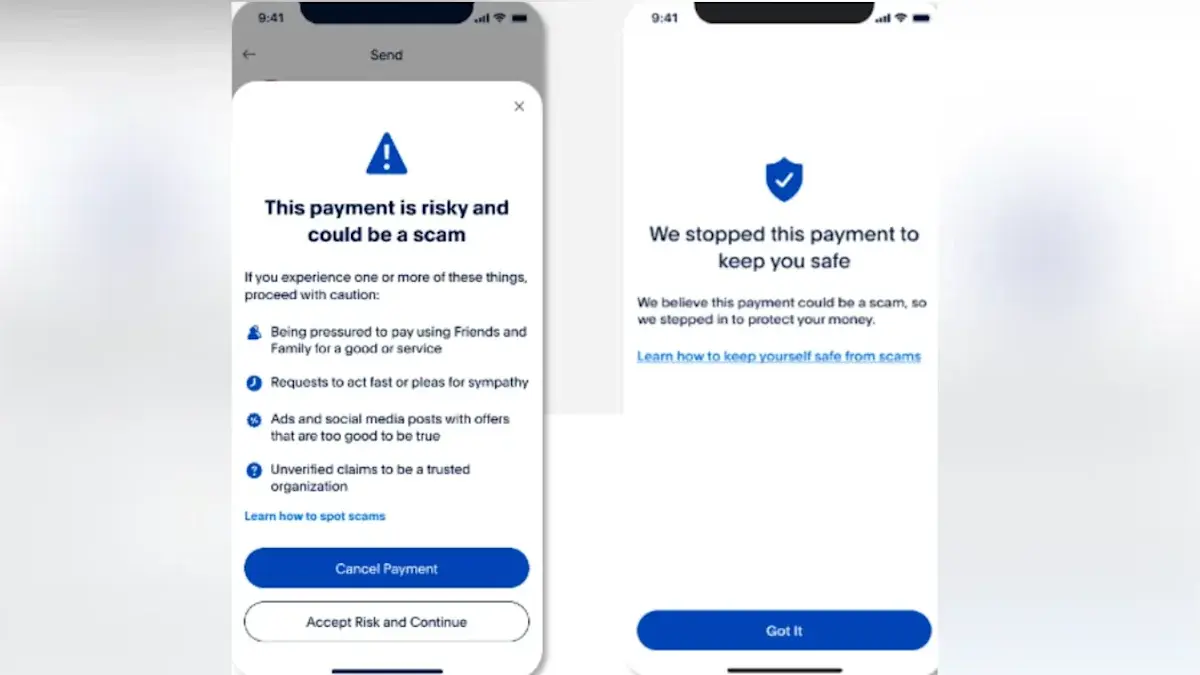
When a payment appears suspicious, users may receive an on-screen warning explaining why the transaction could be dangerous. These notifications provide additional information to help customers reconsider whether they should proceed.
The system can also introduce progressively stronger warnings when its analysis indicates a higher likelihood of fraud.
For transactions identified as extremely risky, PayPal can automatically decline the payment rather than allowing it to proceed.
According to PayPal, the AI models continually learn from changing scam tactics, helping the company recognize suspicious behavior even when it encounters previously unseen fraud patterns.
Why Friends and Family Payments Are a Target for Scammers
Friends and Family payments are designed for sending money to people users already know and trust. However, scammers frequently exploit this feature by pretending to be friends, relatives or trusted contacts.
Fraudsters may contact victims through social media, text messages or other communication platforms and create convincing stories to pressure them into sending money.
Some common examples include:
- Impersonation scams: Criminals pretend to be friends or relatives who urgently need financial assistance.
- Fake online sellers: Scammers convince buyers to send money through Friends and Family payments for products they never intend to deliver.
- Emergency payment requests: Fraudsters invent urgent situations to pressure victims into transferring money without checking the details.
- Social media scams: Criminals use fake accounts and misleading offers to convince people to make payments.
Because Friends and Family transactions are generally not eligible for PayPal Purchase Protection, recovering money sent to a scammer can be difficult.
PayPal's AI-powered alerts aim to identify these risks before customers complete their transactions.
PayPal's Scam Alerts Are Available Across Its Markets
PayPal confirmed that its dynamic scam alert system is available across the global markets in which the company operates.
Venmo users in the United States can also access the protection through eligible Friends and Family payments.
The company designed the system to provide warnings at the point where customers make payment decisions, rather than relying entirely on users to recognize scams themselves.
However, the technology does not guarantee that every fraudulent transaction will be detected. Users still need to examine payment requests carefully and avoid sending money to people they cannot verify.
How Users Can Protect Themselves From Payment Scams
Although AI-powered security tools can help identify suspicious activity, users should continue following basic online payment safety practices.
Here are some important precautions:
- Verify payment requests: Contact friends or relatives through a separate, trusted communication channel before sending money.
- Avoid unexpected payment links: Do not open suspicious links or enter account details on unfamiliar websites.
- Check recipient information: Confirm the recipient's name and account details before approving a transfer.
- Be careful with urgent requests: Scammers often create emergencies to prevent victims from thinking carefully.
- Use Purchase Protection: When buying products or services, use an eligible payment method that offers buyer protection.
- Report suspicious activity: Contact PayPal or Venmo through their official applications if you encounter a suspected scam.
PayPal also recommends reporting suspicious messages and contacting customer support directly rather than responding to unexpected requests for financial information.
AI Is Becoming an Important Part of Digital Payment Security
The introduction of AI-powered scam alerts reflects a broader shift in how financial technology companies approach online fraud.
Traditional security systems often depend on known fraud patterns and predefined rules. However, scammers continuously change their techniques, making it harder for conventional systems to identify every suspicious transaction.
Artificial intelligence offers another layer of protection by analyzing large amounts of transaction data and adapting to emerging patterns.
For PayPal and Venmo, the goal is to identify potential scams early enough to give customers a chance to stop a payment before losing their money.
As digital payments continue to grow, AI-powered fraud detection could become an increasingly important feature across banking applications, payment services and digital wallets.
اترك تعليقاً
لن يتم نشر عنوان بريدك الإلكتروني. الحقول المطلوبة مشار إليها بـ *