

Siemens Energy Says Reliable Data Is the Key to Making AI Work in Power Plants
Artificial intelligence is becoming an important part of the energy industry, but experts believe its success will depend on something more fundamental than advanced algorithms: reliable operational data.
As electricity generation shifts toward renewable energy, power companies are managing increasingly complex systems that combine conventional power plants, wind farms, solar installations, and battery storage. Keeping these different technologies working together requires intelligent control systems, accurate information, and strong cybersecurity.
Mark Robens, Sales Head for North and Western Europe for Controls & Digitalization at Siemens Energy, highlighted these challenges during an appearance on The POWER Podcast. He explained that AI can help energy operators make better decisions, but only when the underlying operational information is accurate, connected, and trustworthy.
Renewable Energy Is Becoming Critical Infrastructure
The growing contribution of renewable energy means that wind and solar installations are playing a much larger role in maintaining electricity supply.
Robens pointed to the potential consequences of a large offshore wind farm suddenly going offline. Losing a 1-gigawatt facility could create significant challenges for grid stability, making reliable monitoring and control essential.
According to Robens, renewable installations should now be treated with the same importance as major conventional power plants. Their control systems must meet demanding standards for security, reliability, and operational performance.
This becomes even more important as electricity networks depend on a wider combination of energy sources.
Managing Different Energy Sources Through One System
Modern power operators are no longer dealing with fleets made up of similar generation facilities. Instead, they must coordinate technologies with different operating characteristics.
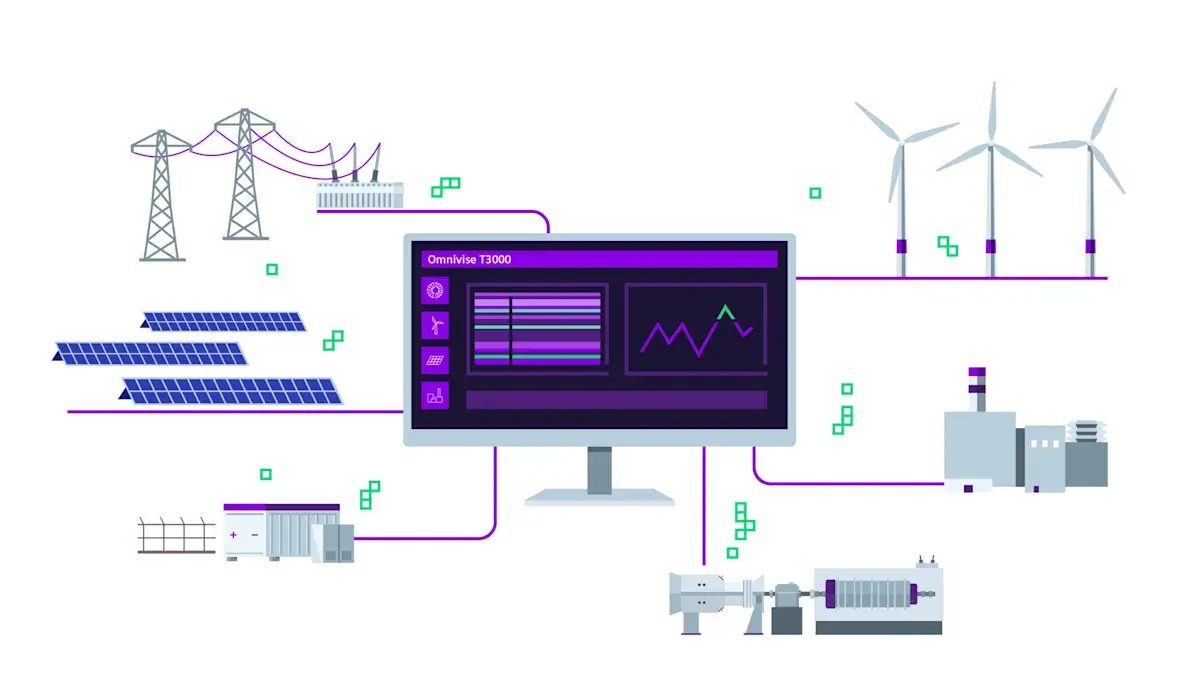
Gas turbines, wind farms, solar panels, and battery energy storage systems all need to work together to maintain a stable electricity supply.
Robens discussed a Siemens Energy project involving a major energy company in South America. The customer operates a multi-location microgrid combining gas turbines, wind power, and battery storage.
The main challenge was coordinating the entire system rather than managing individual power generation assets separately.
Operators need to determine when gas generation should increase, when batteries should charge or release stored electricity, and how to balance energy efficiency with dependable power delivery.
Siemens Energy uses its Omnivise T3000 control system to provide an integrated operational environment for managing these different technologies.
Robens said energy companies are increasingly interested in managing entire generation portfolios instead of purchasing solutions for individual facilities.
Why AI Needs Accurate Operational Data
Artificial intelligence can analyze large amounts of information and identify patterns that may be difficult for human operators to recognize. However, its recommendations are only useful when the information it receives is dependable.
Incomplete measurements, inconsistent records, and disconnected operational systems can reduce the accuracy of AI-generated insights.
For power plants, this is particularly important because decisions involving electricity generation can have consequences for equipment, operational costs, and grid reliability.
Robens emphasized that companies must establish a trusted digital foundation before expecting AI to deliver meaningful improvements.
This includes collecting accurate operational information, connecting different systems, and ensuring that data retains the context needed for effective analysis.
In other words, introducing AI software alone will not automatically make an energy facility smarter.
Cybersecurity Remains a Major Concern
Greater connectivity also creates additional cybersecurity challenges for the energy industry.
As power plants connect operational technology with external IT networks, cloud platforms, and digital applications, protecting critical systems becomes increasingly important.
A cyberattack targeting an energy facility could potentially disrupt operations or affect electricity supply.
Robens highlighted the importance of established security frameworks, including IEC 62443 and the ISO 27000 family of standards.
Energy companies must also consider regional regulatory requirements, including NERC CIP in North America, Germany's KRITIS framework, and European network and information security regulations.
For Siemens Energy, cybersecurity is an essential part of building digital control infrastructure rather than something that should be added after deployment.
Siemens Energy Connects Power Plant Operations Through Omnivise
Many power facilities already use digital technologies, but their systems often operate independently.
Information may remain trapped in separate applications, making it difficult for operators to understand the overall condition of an entire generation fleet.
Siemens Energy is addressing this challenge through its Omnivise ecosystem, which connects operational information from different applications and facilities.
The company describes the relationship between its technologies as "control across, value above."
The Omnivise T3000 system focuses on integrating and controlling different energy assets, while the wider Omnivise ecosystem connects operational data with analytics, fleet management, energy management, and other business processes.
Importantly, the ecosystem is designed to support different technology providers, meaning companies do not necessarily need to operate T3000 to benefit from it.
A Real-World Example: Seven Wind Farms Connected in Portugal
One example involves Portuguese energy company EML S.A., which is moving its renewable energy operations toward greater participation in electricity markets.
According to Siemens Energy, seven onshore wind farms with a combined generation capacity of approximately 250 MW were connected through Omnivise T3000 Edge to a cloud-based operations and analytics environment.
The system provides a unified interface for monitoring the wind farms, handling alarms, and managing supervisory control across all seven locations.
This helps the company gain a clearer understanding of its renewable energy portfolio and coordinate electricity dispatch according to transmission system operator requirements.
The connected infrastructure is also designed to support forecasting, dispatch planning, and bidding optimization.
Future expansion could include additional energy management capabilities and other technologies, including solar power and battery storage.
AI Is Designed to Support Operators, Not Replace Them
Despite the growing interest in automation, Siemens Energy does not see AI as a replacement for human control room employees.
Instead, the technology is intended to help operators understand situations faster, respond to incidents, and spend more time on important operational decisions.
Robens identified several areas where Siemens Energy is exploring AI applications, including:
- Root cause analysis: Helping identify the reasons behind equipment failures and operational problems.
- Turbine optimization: Supporting adjustments to improve turbine performance.
- Incident response: Providing guidance when unexpected operating conditions occur.
- Interactive manuals: Making technical documentation easier to access and understand.
- Operational AI agents: Offering recommendations based on real-time plant conditions.
These applications could help reduce the time required to investigate problems and improve decision-making across complex energy facilities.
However, their effectiveness still depends on accurate information and reliable connections between operational systems.
Siemens Energy Demonstrates 72 Hours of Unmanned Power Plant Operation
Fully autonomous power plants are not yet standard across the energy industry, but Siemens Energy believes the sector is gradually moving toward higher levels of automation.
As an example, Robens mentioned a demonstration carried out with Volkswagen in Wolfsburg, Germany, where Siemens Energy achieved 72 hours of unmanned operation at a power plant.
The demonstration does not mean that fully autonomous power generation has become a widespread reality. However, it illustrates how connected control systems and AI-assisted operations could change the way future facilities are managed.
The Future of AI in Energy Depends on Trust
Artificial intelligence could transform how electricity is generated, monitored, and distributed. But the energy industry's transition will require more than powerful software and advanced algorithms.
Companies first need reliable operational data, integrated control infrastructure, and strong cybersecurity protections.
As renewable energy portfolios become more diverse, the ability to coordinate multiple technologies through connected systems will become increasingly important.
Siemens Energy's approach suggests that the future of AI-powered electricity generation will depend on building a trustworthy digital foundation before moving toward greater automation.
Source: Siemens Energy's Mark Robens interview on The POWER Podcast.
Leave a comment
Your email address will not be published. Required fields are marked *