

Super Mario 64 Mystery Finally Gets a New Clue After 30 Years
A mysterious plaque in Nintendo's legendary game Super Mario 64 has sparked speculation among players for decades. Now, a fan developer has used computational analysis to investigate the blurry inscription, offering a new explanation for one of gaming's most enduring mysteries.
The analysis suggests that the plaque may read “Eternal Star” on its first line and “We Hope So” on its second. Although the result has attracted attention from the gaming community, it remains an interpretation rather than an officially confirmed answer from Nintendo.
The Mystery Behind the Super Mario 64 Plaque
Released for the Nintendo 64 in 1996, Super Mario 64 helped redefine 3D platform gaming. Players explored Princess Peach's Castle, collected Power Stars, and discovered hidden areas throughout the adventure.
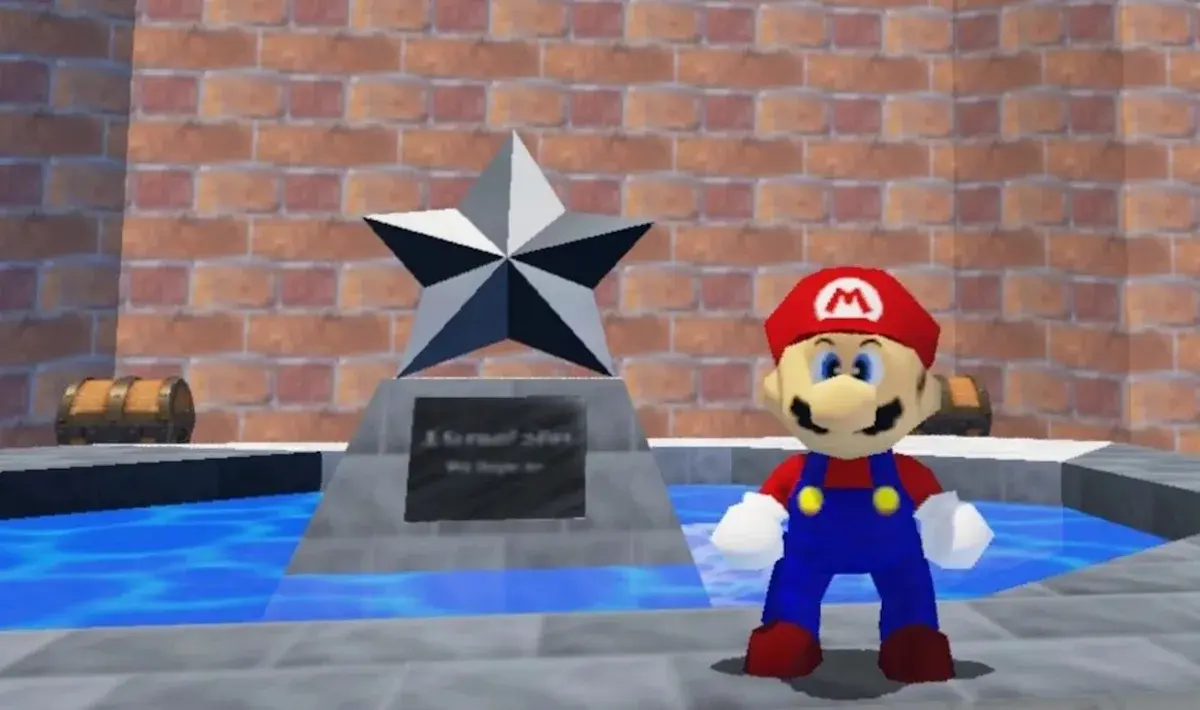
However, a small plaque near the castle's courtyard fountain became famous for a reason unrelated to the main storyline. Its tiny, blurry lettering was difficult to read, encouraging players to develop their own theories about the message.
One of the most popular interpretations was “L Is Real 2401.” Fans believed the phrase might reveal a secret involving Luigi, Mario's brother, who was not playable in the original release.
The theory became an enduring part of Nintendo's gaming folklore, with players searching for hidden clues and possible methods of unlocking Luigi.
How a Programmer Used Computational Analysis
Rather than relying on image enhancement alone, a programmer known as Mochi64 approached the problem using computational analysis.
The difficulty is that the original plaque contains extremely small letters represented by only a few pixels. Enlarging the image cannot reliably restore details that were never clearly preserved in the original texture.
According to reporting by Video Games Chronicle, Mochi64 developed an open-source approach that tested possible words, fonts, and resizing methods against the existing pixels.
The analysis reportedly examined more than 1.2 million word candidates and compared how closely different interpretations matched the plaque's appearance.
The phrase “Eternal Star” on the first line and “We Hope So” on the second produced a better match under the scoring method used by the programmer than the popular “L Is Real 2401” interpretation.
That does not prove the proposed wording is correct. It means the candidate performed better under the particular assumptions and comparisons used in the analysis.
What Does “Eternal Star, We Hope So” Mean?
If the proposed reading is correct, the wording could relate to the star imagery and collectible objectives throughout Super Mario 64.
Power Stars are central to the game, helping Mario unlock new areas of Peach's Castle and progress through the adventure. The words “Eternal Star” would therefore fit the game's visual themes.
The second line, “We Hope So,” is more ambiguous. It could be a playful message from the developers, a reference to the game's collectibles, or something else entirely.
Without an explanation from Nintendo's original development team, any interpretation of the message's meaning remains speculative.
Why Fans Connected the Plaque to Luigi
The “L Is Real 2401” theory became popular because players hoped the inscription contained a clue to unlocking Luigi as a hidden character.
During the 1990s, rumors about secret characters and hidden game content were common in gaming magazines and online communities. Speculation surrounding Super Mario 64 grew even stronger as players searched the castle for undiscovered secrets.
The game's development history also contributed to the discussion. Shigeru Miyamoto has spoken about experiments with multiplayer gameplay during development, helping fuel interest in the possibility that Luigi might have been planned for the game.
Despite years of speculation, Luigi was not found as a playable character in the original Super Mario 64. The mysterious plaque continued to inspire theories long after the game's release.
Can Modern Technology Finally Solve the Mystery?
Computational analysis offers a different way to investigate old gaming mysteries. By comparing possible text against the original image, researchers can evaluate interpretations more systematically than by simply enlarging a blurry screenshot.
However, the technique has limitations. The result depends on the candidate words, font assumptions, image-processing methods, and scoring criteria included in the analysis.
A phrase that produces the closest match is not necessarily the phrase originally intended by the artist. Several different messages may be difficult to distinguish when their letters are represented by so few pixels.
The open-source nature of Mochi64's approach gives other enthusiasts an opportunity to examine the method and test alternative interpretations.
That makes the result an interesting contribution to the investigation, even if the exact inscription remains uncertain.
Super Mario 64's Legacy Continues
Nearly three decades after its release, Super Mario 64 remains influential because of its approach to three-dimensional movement, exploration, and camera control.
The game helped establish design principles that became common throughout 3D platformers and action-adventure games. Its influence can be seen in the way later titles allow players to move freely through three-dimensional environments.
The game's lasting popularity has also encouraged speedrunning, fan modifications, community challenges, and continued investigation into hidden details.
The plaque mystery demonstrates how a small visual element can become an important part of a game's history when players keep returning to it and sharing their discoveries.
Final Thoughts
A new computational analysis has given Super Mario 64 fans another possible answer to a mystery that has persisted for around 30 years.
The proposed reading, “Eternal Star” and “We Hope So,” appears to match the plaque's tiny pixel patterns better than the famous “L Is Real 2401” theory under the method used by Mochi64.
Nevertheless, the finding remains unconfirmed, and Nintendo has not officially verified the wording. For now, the analysis provides a promising new clue rather than a definitive solution.
Whether the mystery is ever fully settled or not, the discussion shows why Super Mario 64 continues to fascinate gamers long after its original release.
Leave a comment
Your email address will not be published. Required fields are marked *