


AI Could Reshape 61% of Pakistan’s Service Jobs, World Bank Warns
Artificial intelligence (AI) is expected to bring significant changes to Pakistan’s job market, particularly in the service sector, according to findings from the World Bank. While AI tools could help businesses improve productivity and reduce costs, the technology may also change how millions of workers perform their jobs.
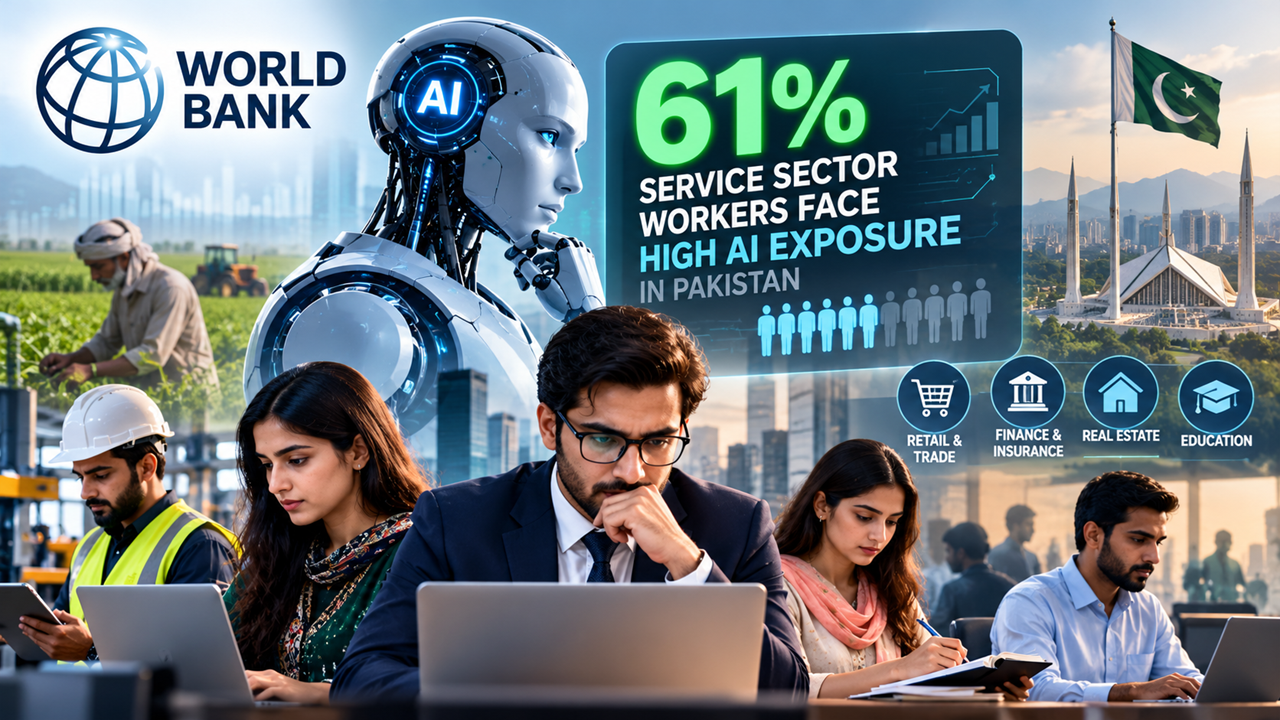
A recent World Bank report, Job Opportunities and AI in Pakistan, highlights the growing exposure of Pakistani workers to AI-powered technologies. The report estimates that 61% of service-sector workers are employed in occupations with above-median AI exposure, making services one of the areas most likely to experience changes as businesses adopt AI.
However, exposure to AI does not automatically mean that a job will disappear. In many occupations, AI can assist workers with routine tasks, improve efficiency, and allow employees to focus on responsibilities that require human judgment and expertise.
Which Jobs in Pakistan Are Most Exposed to AI?
The World Bank's findings indicate that AI exposure varies considerably across Pakistan's economic sectors. Jobs involving information processing, communication, administration, and other cognitive tasks are generally more exposed to AI than occupations centred on physical labour.
Within Pakistan's service sector, wholesale and retail trade, finance, insurance, real estate, and education stand out, with more than 80% of workers in each of these sectors employed in highly AI-exposed roles.
These industries rely on activities that AI tools can increasingly support, including analysing information, preparing documents, responding to customer enquiries, processing transactions, and assisting with administrative work.
The level of exposure does not mean that every worker in these industries will be replaced. Instead, it suggests that businesses may increasingly introduce AI tools into everyday operations, changing the skills employees need to remain competitive.
Why Pakistan's Service Sector Could Face Major Changes
Pakistan's service sector includes banks, retailers, educational institutions, real estate businesses, customer support centres, and professional service providers.
Many of these organisations handle large amounts of information and repetitive digital tasks, making them potential candidates for AI adoption.
For example, banks could use AI to support customer service and document processing, while retailers may use it for inventory management, customer recommendations, and demand forecasting. Educational institutions could also adopt AI tools to assist with lesson preparation, learning resources, and administrative work.
Real estate businesses may use AI to analyse market information, prepare property descriptions, and respond to customer enquiries.
These applications could help companies reduce routine workloads and improve service delivery. At the same time, workers may need to learn how to supervise AI-generated results, solve more complex problems, and provide services that require personal interaction.
Does AI Mean Job Losses for Pakistani Workers?
One of the most important findings is that AI exposure and job replacement are not the same thing.
The World Bank report estimates that around 18% of employed workers in Pakistan are in occupations with both high AI exposure and high potential for human-AI complementarity. These are jobs where AI can assist employees rather than simply replace their work.
By comparison, approximately 8% of employed workers are in highly exposed occupations with low human-AI complementarity, where the risk of tasks being substituted by AI may be greater.
This distinction matters because many jobs involve a mixture of routine and specialised responsibilities. AI may automate some activities while leaving decision-making, accountability, communication, and complex problem-solving to human workers.
For Pakistan, the challenge will be helping employees and businesses adapt before changes in technology affect employment opportunities and income.
Manufacturing and Agriculture Face Lower AI Exposure
The World Bank's findings show a substantial difference between the service sector and industries involving more physical work.
Manufacturing has an estimated 7% of workers in highly AI-exposed roles, while other industrial sectors stand at approximately 5%. Agriculture has the lowest exposure, with less than 1% of workers in highly exposed occupations.
These figures reflect the nature of work across different industries. Many manufacturing and agricultural jobs involve operating machinery, handling materials, working outdoors, or performing physical tasks that current AI systems cannot independently carry out.
Nevertheless, lower occupational exposure does not mean these industries will remain untouched by technology. AI can still support agricultural planning, crop monitoring, predictive maintenance, quality control, and supply-chain management.
Over time, combining AI with robotics, sensors, and other technologies could also change the types of tasks performed in factories and on farms.
AI Could Create New Opportunities for Pakistan
Despite concerns about employment, AI could provide Pakistan with opportunities to improve productivity and expand its digital economy.
Businesses that adopt AI effectively may be able to serve more customers, develop new products, and compete more successfully in international markets. Pakistani freelancers and technology companies could also use AI tools to improve their services and reach clients more efficiently.
The country already has a growing digital services industry, including software development, graphic design, content creation, translation, and business process outsourcing.
However, workers may face increasing competition as AI tools become capable of performing some tasks that were previously offered as paid services. Developing specialised skills and learning how to use AI effectively could therefore become increasingly important.
Rather than relying exclusively on tasks that AI can perform automatically, workers may benefit from combining technical knowledge with creativity, communication, industry expertise, and problem-solving abilities.
Why Digital Skills and Training Will Matter
The transition to an AI-enabled economy will require investment in education, digital infrastructure, and workforce training.
Universities and vocational institutions can help prepare students by teaching practical AI skills alongside core subjects. Employers can also provide training that helps existing staff integrate AI into their work instead of treating the technology solely as a replacement for employees.
For small businesses, affordable AI tools could create opportunities to improve operations without requiring large technology budgets. However, businesses will need to consider data privacy, accuracy, cybersecurity, and the risks of relying too heavily on automated systems.
Government policies that support digital connectivity, innovation, private-sector growth, and relevant training could also help Pakistan benefit from AI adoption while reducing disruption for vulnerable workers.
Final Thoughts
The World Bank's findings highlight how artificial intelligence could reshape Pakistan's employment landscape, particularly across service industries where digital and information-based tasks are common.
With 61% of service-sector workers in occupations with above-median AI exposure, the potential changes are significant. Yet the findings do not indicate that 61% of these workers will lose their jobs.
The eventual impact will depend on how companies adopt AI, how workers develop new skills, and whether the technology complements human capabilities or replaces particular tasks.
For Pakistan, the priority should be preparing workers for changing job requirements while helping businesses use AI to improve productivity, create opportunities, and compete in an increasingly digital economy.
Bir yorum bırakın
E-posta adresiniz yayınlanmayacaktır. Gerekli alanlar * ile işaretlenmiştir